
The past couple of months, I've had my head buried in media about anxious avoidant attachment. I even found myself talking to a couples counsellor about it. There's something about the way we relate to each other that keeps most of us up at night at least once in our lives.
One source I kept coming back to was Jessica Fern's book, Polysecure. The book ostensibly talks about building secure attachments within non-monogamous relationships (that's when you're consensually involved with one or more romantic partners at the same time).
But it's really a book about attachment on the whole, and it got me thinking about how complicated our attachment patterns can be, especially when we want connection but also feel the need to protect ourselves from it.
So in this piece, we’ll unpack anxious-avoidant attachment, the difference between the two, how therapy might help heal from attachment issues, and how to develop a more secure attachment style.
What Is Anxious Avoidant Attachment?
The meaning of anxious avoidant attachment is the tension between:
- Wanting to build intimate relationships, and
- Feeling the need to protect yourself from the hurt you may feel in those bonds.
To understand where this tension comes from, let’s jump back to the 1950s, when attachment theories were developed.
For a long time, many researchers believed that an adult’s attachment style was anchored in infancy, based on the relationship with their primary caregiver.
Today, decades of research from expert therapists tell us that that isn’t actually the case.
Attachment styles are actually fluid (meaning they change over time), and we create stable bonds by engaging in productive conversations and repairing our attachment in the wake of conflict - rather than having a fixed attachment pattern predetermined in childhood.
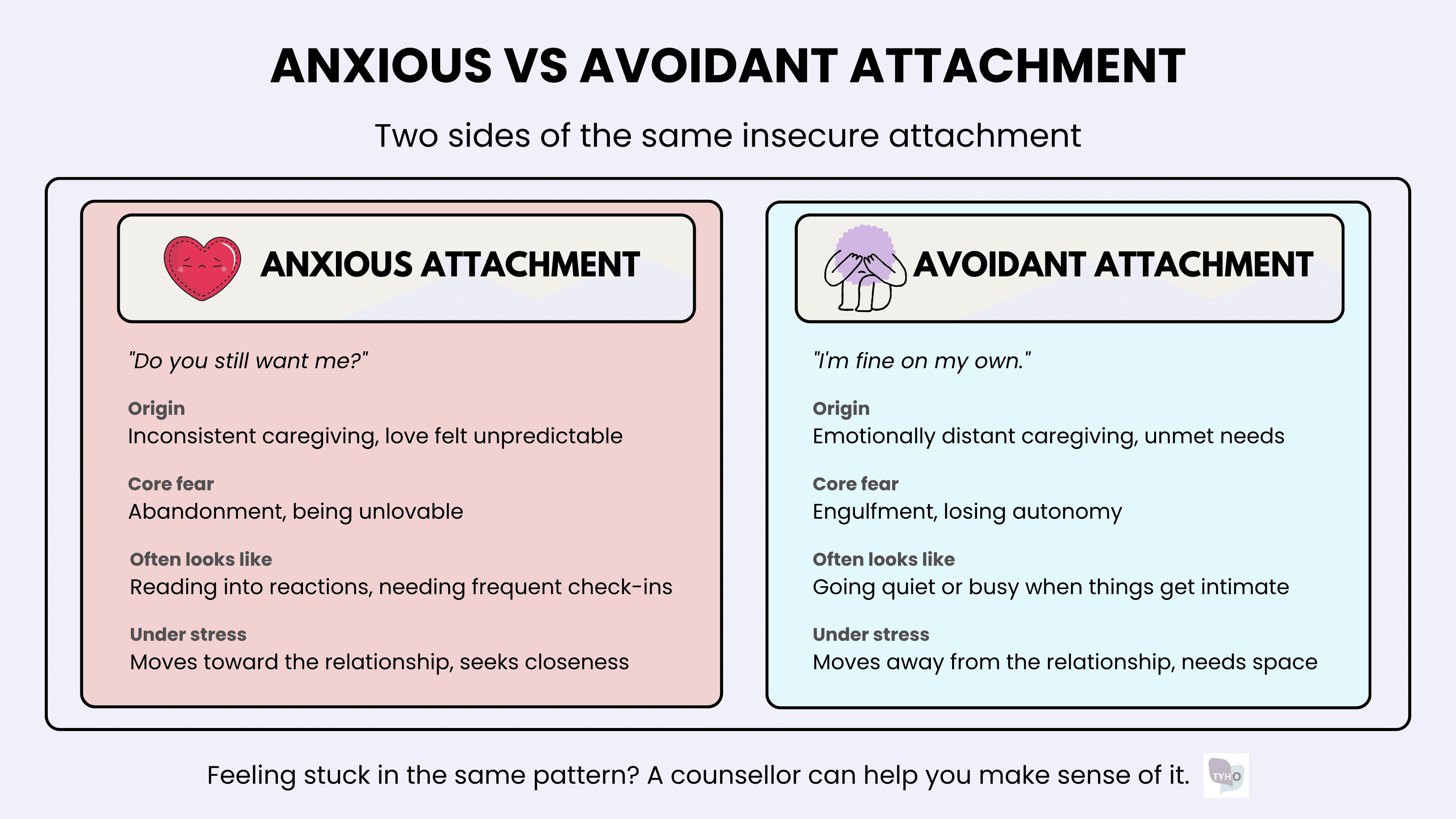
So, what do anxious and avoidant attachment styles look like on their own?
What Is Anxious Attachment?
Anxious attachment could involve:
- A strong desire to form relationships
- Fear of abandonment
- Constant need for reassurance
If you’re anxiously attached, you may be hyper-aware of your partner’s emotions and behaviours.
Have you ever noticed your partner sighing and immediately felt panicked? ‘Maybe I did something wrong. 'How do I even tell if they love me?!' You may be able to tell theoretically that your thoughts are likely untrue, but your anxious attachment may cause you to interpret neutral signals as negative or dangerous.
Below are some things you may find yourself doing if you’re anxiously attached:
- Reaching out more for reassurances
- Feeling upset or anxious when you’re not given reassurances
- Thinking about the relationship very often (even when the bond seems fine)
- Trying to make sure your relationship is ‘perfect’
- Ignoring your needs to satisfy your partner

What Is Avoidant Attachment?
Avoidant attachment could involve:
- A strong desire for independence
- Discomfort with emotional intimacy
- Difficulty trusting or relying on others
If you’re avoidantly attached, you may be hyper-aware of your own need for space and independence in a relationship.
Have you ever noticed your partner wanting to get closer and immediately felt the urge to pull away? ‘Maybe this is getting too serious. Do I really need to talk about how I feel?’ You may understand theoretically that your partner is simply trying to connect with you, but your avoidant attachment may cause you to interpret closeness as overwhelming or threatening.
Below are some things you may find yourself doing if you’re avoidantly attached:
- Pulling away when a relationship starts to feel too intimate
- Feeling uncomfortable when your partner seeks emotional reassurance
- Avoiding conversations about your feelings or conflicts
- Prioritising independence even when you need support
- Finding reasons to create distance from your partner
- Struggling to ask for help or rely on others
Is Anxious-Avoidant Its Own Attachment Style?
While anxious and avoidant are two different types, anxious-avoidant attachment is its own style, also known as disorganised attachment.
While the other attachment styles may feel unsafe for the individual, the disorganised style feels safer. For example, based on attachment theory, a child with a disorganised attachment style may keep themselves safe from their unhelpful caregivers by:
- Acting aggressively towards the caregiver
- Becoming self-reliant
- Refusing to be compliant with the caregivers’ demands
Note: If you think you may have a disorganised attachment style, talking to a couples counsellor may help you make sense of how the patterns could be reflected in your interpersonal relationships.
Research on the disorganised style is quite limited, and as we previously saw, attachments are always fluid and best made sense of by discussing your life story and context in detail!
Here’s a review from one of our clients who benefitted from a couples counselling session to improve their relationship:
“I recently had the pleasure of working with Edmund for couples counselling, and I have to say that it was an incredibly positive experience. Edmund was incredibly empathetic and understanding, and he helped my partner and me resolve communication issues that had been causing a lot of tension in our relationship. What I appreciated most about him was his ability to listen carefully and provide practical advice that we could actually apply in our daily lives. He was never judgmental or dismissive, and he always made us feel heard and valued. Overall, I would highly recommend Edmund to anyone seeking couples counselling. He is a skilled and compassionate therapist who truly cares about his clients, and I am so grateful for the positive impact he has had on our relationship.”

Anxious Attachment vs. Avoidant Attachment: What's the Difference?
Don’t anxious attachment and avoidant attachment look like vastly different styles?
Somewhat unexpectedly, anxious and avoidant are both insecure attachment styles; they only differ in their responses and reactions.
While an anxiously attached person may seek reassurance out of fear, an avoidant person may rely heavily on independence due to their fear.
The Anxious Avoidant Attachment Cycle
If you’re an active member of the modern dating scene, you may be aware of situationships (ie a non-committal romantic and/or sexual dynamic between two people).
At the heart of this intense, almost obsessive dynamic is a repeating push-and-pull cycle where:
- One person pushes for connection (anxious)
- The other pulls away (avoidant)
So each person’s attempt to feel secure makes the other feel less safe.
Here’s how the anxious avoidant attachment cycle may look:
Alex: Hey, what you up to?
Sam: Just been busy.
Alex: Okay. I just feel like you’ve barely talked to me today.
Sam: I don’t really want to have this conversation right now.
Alex: why? You sound off… did I do something?
Sam: Nothing happened really, I just need some space.
Alex: but now I’m worried that you’re gonna stop talking to me again :(
Sam: *Stops replying*
Alex: Are you ignoring me?
And there it is: the cycle starts to feed itself. The more Alex reaches out for reassurance, the more pressured Sam feels and pulls away. The more Sam pulls away, the more anxious Alex becomes and reaches out again.
Neither person is necessarily trying to make the other feel unsafe. They’re both trying to feel more secure, but their attempts end up triggering each other.

“‘You are the source of your happiness, love, courage, emotional regulation and purpose, and the sooner that you can release your partner from being the source of these experiences, the better for everyone involved.’ - Jessica Fern, Polysecure.
Therapy for Anxious Avoidant Attachment
Therapy for anxious avoidant attachment may be useful in many situations. Here’s a common example:
Anxious avoidant attachments, and tensions may not manifest in a relationship using the language of attachment theory (eg ‘my mom didn’t give me enough love, so now I need more of it’).
Instead, the conflicts are likely to come up around mundane issues or at a surface level (eg ‘why aren’t you talking to me’ or ‘can you please give me some space’).
In couples counselling, becoming self-aware of these seemingly invisible attachment styles may help you unpick how these patterns influence day-to-day interactions with your partner.
Talking to a professional may also help you better understand your partner and improve the overall quality of your relationship and set realistic couple goals.

Difference Between Individual Therapy & Couples Therapy
The type of talk therapy service you choose may help you in specifc areas of life. A counsellor at Talk Your Heart Out may also guide you toward the right service depending on your needs and therapy goals.
1) Individual Therapy
Individual therapy may help you if you’re leaning more towards better understanding yourself and how your attachment styles affect all your interpersonal relationships.
You may explore your:
- Emotions
- Triggers
- Past and negative childhood experiences
- Past relationships
- Family history and relationship with primary caregivers
Therapists may also guide you towards developing healthy coping mechanisms and understanding your relationships with not just people, but also other elements such as:
- The world
- The environment
- Food
- Relationships with yourself
2) Couples Therapy
Couples therapy may help you better understand how your attachment styles affect your relationship with your partner.
You may explore your:
- Communication patterns
- Emotional needs
- Triggers and reactions
- Relationship dynamics
- Past experiences that may affect your relationship
Therapists may also help you and your partner develop healthier ways to communicate, manage conflict, and respond to each other’s needs.
You may also learn how to:
- Recognise each other’s attachment patterns
- Break unhealthy push-and-pull cycles
- Build trust and emotional safety
- Develop a more secure attachment within your relationship
The Nested Attachment Model
The Nested Attachment Model suggests that our sense of safety in relationships is also shaped by the environment, and not just by interpersonal relationships.
At first, the idea of being ‘attached’ to the environment might sound a little strange. But when you think about it, people who experience racism, homophobia or ableism, for example, may have good reason to feel less safe and trusting in the world around them.
When your environment repeatedly tells you that you aren't safe, valued or protected, that can inevitably shape how you relate to other people.
So, if our social environments can influence how safe we feel in relationships, why wouldn't our physical and wider environment do the same?
How Do You Develop a Secure Attachment Style?
Usually, the first step in healing from anxious avoidant attachment is meeting ourselves with an understanding heart
Personally for me, the self-awareness and the brutal acceptance of this is who I am, and this is my reality helped me discover how to:
- Relate better with people I love
- Tackle complicated feelings when they surface during arguments
To develop a secure attachment style, we may have to challenge our core belief, which could currently sound like:
‘The love I receive is conditional. My safety depends on other people.’
Below are some steps you can practice to reframe the belief into the thought you want to hear: that you are worthy of love and safety regardless of external validation.
Healing Anxious Avoidant Attachment
Try the following:
- Pause and breathe when anxiety starts to surface. Sometimes, that might simply mean letting yourself cry.
- Remind yourself that feelings aren’t facts. Feeling abandoned doesn’t necessarily mean that you’ve been abandoned.
- Question anxious thoughts instead of immediately believing them.
- Ask yourself what you’re actually looking for. Sometimes, you may not be looking for a specific person as much as you’re looking for a particular feeling, such as reassurance, safety or connection.
- Your inner child may feel like the world is ending, but you’re the adult now. You have a toolkit of things you can try to help yourself feel better: try journaling, listening to music, watching Netflix, going for a walk, making yourself a matcha, cleaning, sleeping or talking to a friend.
- Remind yourself of the secure relationships you already have. Having secure friendships and relationships in your life is proof that you’re capable of building safe connections.
- Give more attention to the relationships that make you feel secure rather than clinging to the ones that make you feel uncertain.
- Try not to treat one person as your entire support system when you have other people and relationships you can lean on.
Frequently Asked Questions
1) Is it possible to heal from anxious avoidant attachment?
Yes, it is possible to heal from anxious avoidant attachment, as attachment styles are fluid and constantly changing. Talk to a therapist in Malaysia to explore more about your style and how you can cope better.
2) What is the hardest attachment style to live with?
The common consensus is that the disorganised attachment style is the hardest to live with, because it’s born out of complex traumatic experiences, and involves a mix of anxious and avoidant tendencies.
People with this type of attachment often experience a catch-22 where, regardless of whether they choose connection or distance, they tend to experience discomfort.
If you relate to the above, talking to a couples counsellor may be beneficial.
3) Who are avoidants most attracted to?
People with avoidant attachment may be drawn to partners who give them just enough closeness to feel connected, while still giving them plenty of space and independence.
Interestingly, they may also find themselves drawn to ambivalent partners, who can create a familiar push-and-pull dynamic. An ambivalent partner may seek closeness and reassurance, while the avoidant partner pulls back when the relationship starts to feel too intense.
This can create a cycle where each person’s attachment needs reinforce the other’s. The ambivalent partner’s pursuit may trigger the avoidant partner’s need for distance, while that distance makes the ambivalent partner seek even more reassurance.
Final Word
Perhaps the most important thing to remember about attachment is that none of these patterns is a life sentence. We may learn certain ways to protect ourselves, but we can also learn new ways to relate, connect, and feel safe.
Individual therapy can give you space to understand your own attachment patterns, while couples therapy can help you and your partner understand the cycle you may be caught in together.
I’ll leave you with this: Attachment itself is not our enemy, and needing each other is human. :purple_heart:
Talk to a professional therapisttoday to better understand how interpersonal relationships and attachments work.