

Most of us have come across the different types of narcissists, which have now entered the popular lexicon as labels for someone who is seen as selfish or ‘too full of themselves’.
In psychology, narcissism is more accurately defined by various patterns involving grandiosity, a need for admiration, and being the centre of attention, along with an impaired sense of empathy.
Several people exhibit narcissistic qualities without actually having a diagnosable condition. For example, TYHO counsellors see almost 49% of clients who seek help with narcissistic elements in their relationships, such as gaslighting and control issues.
There is some debate about what different types of narcissism are. Broadly speaking, there are five types. Understanding the different types of narcissism can go a long way to help make sense of narcissistic personality disorder (NPD) and also help people who have experienced narcissistic abuse heal.
The Spectrum of Narcissism
Firstly, we usually view narcissistic traits as something that only some people exhibit, but in reality, it is a spectrum, and most people lie somewhere on the spectrum.
What defines narcissism is the consistent incapacity to genuinely empathise with another person and feel responsible for each other’s actions in a way that produces real change in the relationship.
Note: If you are dating a narcissistic person, you may feel that your sense of self is being compromised in favour of the one the narcissist concocts (ie behaving unlike yourself). If you doubt that you’re struggling with your sense of self, talking to a therapist might help.
However, if you and your partner realise that either one of your narcissistic tendencies is starting to seep into the quality of your relationship, seeing a couples therapistmight be greatly beneficial.

Finally, if you suspect that you or someone close to you might have a diagnosis of narcissistic personality disorder (NPD), seeking the support of a mental health professional is important as NPD may often present itself with other comorbid mental health conditions.
What are the Types of Narcissism?
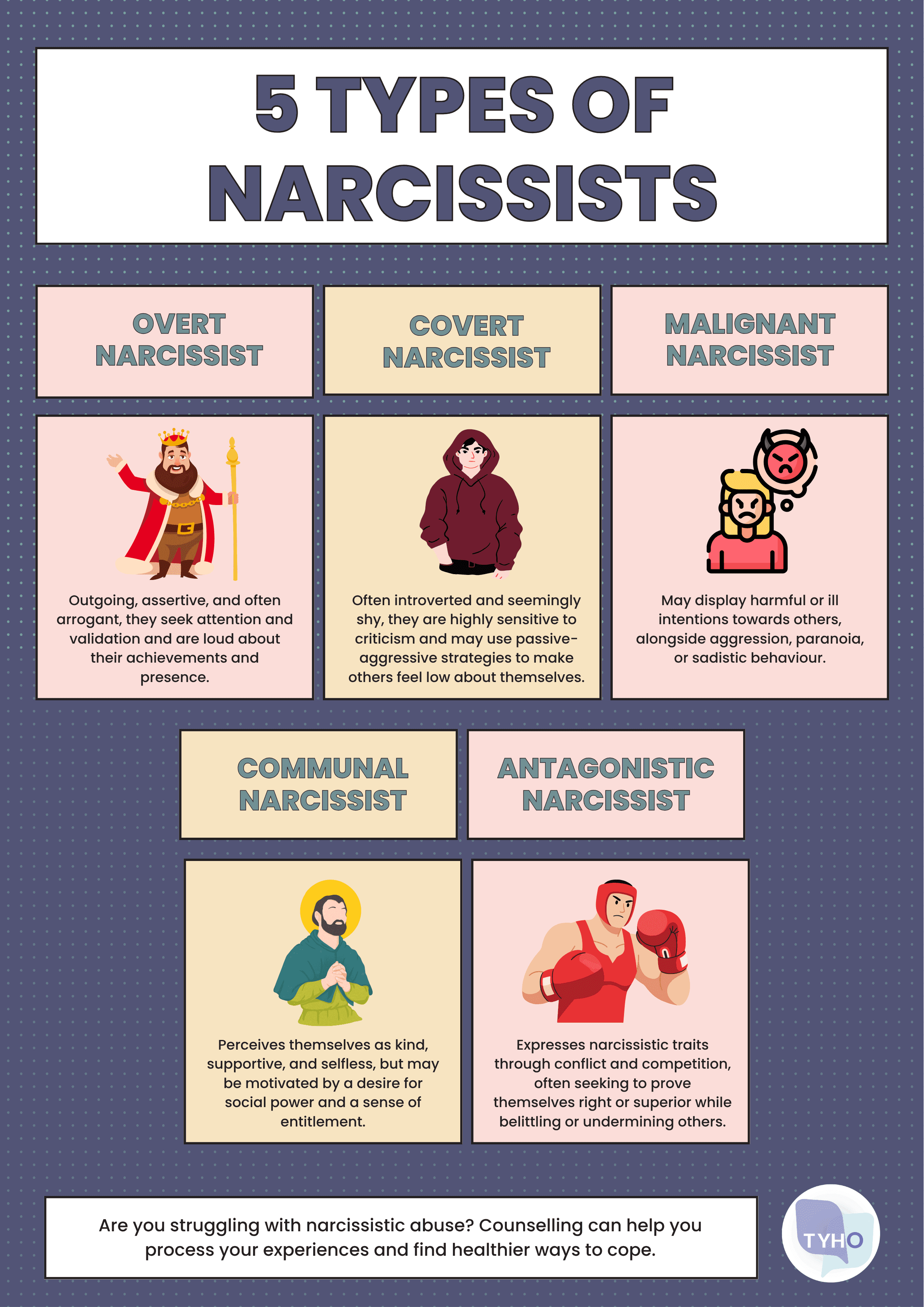
The types of narcissists are classified according to the different traits individuals exhibit. There are now five different recognisable groupings of the various traits of narcissism.
1) Overt Narcissist (or) Grandiose Narcissist
An overt narcissist is also known as a grandiose narcissist, which is the type of narcissist you may have seen typically represented in media, and is also the most commonly recognisable.
Overt narcissists are outgoing, assertive, and often arrogant. The individual’s narcissism is directed ‘outward ’ - meaning that they seek attention, validation, and are loud about their achievements and presence.
If you are in a relationship with someone who exhibits grandiose narcissistic traits, you may notice that they are emotionally controlling, manipulative, dismissive of your feelings, and dominant in the relationship, especially in a way that may make you uncomfortable.
2) Covert Narcissist (or) Vulnerable Narcissist
A covert narcissist is also known as a vulnerable narcissist, and the signs of this type of narcissist are quite hard to identify at first glance.
Vulnerable narcissists are introverted, often appearing shy; yet they are extremely sensitive to criticism and use passive-aggressive strategies to make others feel low about themselves.

3) Malignant Narcissist
As the name suggests, a malignant narcissist is a type of narcissist who may have harmful or ill intentions towards other people.
Apart from the typical signs of narcissism, a malignant narcissist may also be aggressive, paranoid or sadistic (ie taking joy in other people’s visible pain).
These individuals may also disregard or appear careless regarding the rights and safety of other people, especially when they’re responsible for someone’s wellbeing.
If you find yourself in a crisis with a malignant narcissist, reach out to one of the crisis numbers on our page. Alternatively, you may also book a same-day session to talk to an expert counsellor if you’re experiencing narcissistic abuse.
4) Communal Narcissist
A communal narcissist is a type of narcissist who perceives themselves as being altruistic or morally rightful. They define themselves as kind, supportive, and selfless.
However, a communal narcissist’s behaviour is a stark contrast, as their actions are motivated by a desire for social power and a sense of entitlement.
5) Antagonistic Narcissist
An antagonistic narcissist is someone whose narcissistic traits are often expressed through conflict, competition, and a strong need to feel superior to others.
Antagonistic narcissists may be argumentative, competitive, and quick to perceive others as a threat or challenge to their sense of superiority. Their narcissism is often directed towards ‘proving’ themselves right or better than others, which may lead them to belittle, undermine, or provoke people around them.
The Long-Term Effects of Narcissistic Abuse
Narcissistic abuse can take many forms, including controlling behaviours, subtle manipulation, gaslighting, verbal abuse, and more.
Regardless of the type of narcissist and the intensity of the traits, if you engage with a narcissistic person for a long period of time, you may have a long-term impact on mental health.
The good news is that the effects are manageable and recoverable through consistent talk therapy.
Below are some common long-term effects of narcissistic abuse:
- Low self-esteen
- Relationship issues
- Mental health issues such as emotional overwhelm or post-traumatic stress disorder
- Physical health issues such as migraines or sleep disturbances
- Eating disorders due to control over food choices
- Issues with managing stress or daily functioning
If you’re experiencing suicidal thoughts or are in a harmful situation, visit a crisis resource page for immediate access to support.
How to Handle a Narcissist
Handling a narcissist may depend on the type of narcissist you may be engaging with. At the core, all people who exhibit narcissistic tendencies struggle with low self-esteem; however, they may deal with their feelings by controlling and manipulating others.
Research shows that a successful way to handle any type of narcissist is to establish emotional and physical boundaries with the person.
Emotional boundaries could mean:
- Refusing to let other people’s emotions define your mood or day
- Saying ‘no’ without guilt
- Moving away from guessing or fixing others’ feelings
Physical boundaries could mean:
- Moving to a different room or house
- Removing yourself from the situation by leaving the house during an argument or a silent treatment
- Cutting ties with the narcissistic partner
- Choosing not to respond to a narcissistic person’s texts or calls
Individual Counselling: Recovery from All Types of Narcissists
Handling everything on your own in these situations can be mentally exhausting. This is where counsellors in Australia can help you:
- Make sense of your own emotions
- Maintain your sense of self while dealing with the type of narcissists in your life
- Identify any negative childhood experiences that may be causing you to seek out harmful relationships
- Develop self-compassion and self-care strategies
At TYHO, nearly 4% of users have found therapy helpful while dealing with narcissists.
However, narcissistic abuse can often be difficult to recognise, particularly for those on the receiving end of it. Hence, it’s important to have a chat with an expert to identify what issues you may be struggling with, and whether emotional abuse is one of them.

Over 50% of people see significant progress within 15-20 sessions.
Book a session todayFrequently Asked Questions
1) What are the different types of narcissists?
The different types of narcissists are:
- Overt Narcissist (or) Grandiose Narcissist
- Covert Narcissist (or) Vulnerable Narcissist
- Malignant Narcissist
- Communal Narcissist
- Antagonistic Narcissist
2) What is a malignant narcissist?
A malignant narcissist is someone who may have harmful intentions or notions towards other people. Signs of malignant narcissists include:
- Aggression
- Dismissal of other people’s safety or basic rights
- Verbal or physical harm to others
- Arrogance
If you’re experiencing abuse from a malignant narcissistic person, talking to a psychotherapist may be helpful.
3) How can I effectively handle a narcissist?
To handle a narcissistic person, try to:
- Move away from the person and fulfil your emotional needs with people who care for you
- Set emotional and physical boundaries
- Talk to a counsellor or a mental health professional to receive expert guidance
- Seek out friendships and relationships that nurture your soul and focus on your own dreams
4) What are the 7 signs of narcissism?
The seven signs of narcissism are:
- Inflated sense of self-importance
- Strong need for admiration and validation
- Sense of entitlement
- Difficulty empathising with others
- Tendency to manipulate or exploit others
- Hyper-sensitive to criticism
- Preoccupation with status, success, or superiority
Final Word
Here are some reminders if you’re struggling to handle someone who has a type of narcissistic tendency:
You don’t need a narcissistic person’s permission to:
Set boundaries
Protect yourself
Move away from the relationship
Seek professional help
You’re not alone. If you feel stuck, begin by labeling your emotions. Narrate your story.
As Lisa A. Romano once said, “Naming what happened to you is the beginning of reclaiming your story. You don’t need a diagnosis. You need language that fits your experience.”