
Behind every ‘I hate my life’, there’s a quieter ‘Does it ever get better?’ that’s like a secret buried underneath.
Hating your life means carrying the weight of dissatisfaction and hopelessness…all the while doing the things you’re supposed to be doing, like cooking, working, smiling for pictures, and so on.
One of our counsellors at TYHO spoke about how perfectionism can lead us to feel like we hate our lives, and here I provide an indirect quotation:
The high-pressure environment might unintentionally reinforce our perfectionistic tendencies, and when it becomes too rigid, one of the fears we develop is being fundamentally defective or being displeased with ourselves and our lives. (Watch the full recording here)
But does it ever get better? What I’ve personally learnt is that these questions, that are like whispers, are the key to our coping mechanisms. If you’re asking yourself ‘how do I start feeling better’, you’ve already called out for help.
Let us offer you that help through resources on understanding why you may hate your life so much and tips on finding hope again.
What Does It Mean if I Hate My Life?
Hating your life could mean feeling deep dissatisfaction with how things are right now and being unable to choose a way forward.
Esther, from the book The Bell Jar, imagines sitting under a fig tree and fantasises about all the possible lives she could be living.
The book narrates that each fig represents a different life she could choose: becoming a writer, a chef, a traveller, a stay-at-home wife, etc. Esther wants all of them but can't decide. She is unhappy with her current life and with the idea of choosing only one different path.
The above could happen due to two main underlying reasons:
- Emotional exhaustion
- Hopelessness
1) Emotional Exhaustion
Signs of emotional overwhelm or exhaustion that could make you feel like you hate your life include:
- Feeling tired all the time
- Struggling to concentrate
- Feeling mentally drained (eg unable to maintain small conversations)
- Trouble sleeping or struggling with some type of insomnia
- Absentmindedness
- Headaches or migraine
- Mood swings or feeling bursts of emotions
- Feeling depressed or sad all the time
- Feeling pessimistic or cynical

2) Signs of Hopelessness
Signs of hopelessness that may make you feel like you hate your life include:
- Giving up on career opportunities
- Avoiding plans
- Losing interest in personal goals
- Staying in unhappy relationships
- Isolating from friends
- Neglecting self-care
- Expecting rejection or failure
- Feeling stuck in unhealthy patterns (eg maladaptive behaviours)
- Struggling to imagine a fulfilling future
How to Cope if I Hate My Life: 3 Tips to Feel Better
It’s completely normal to lose motivation and hope in life. You are not alone.
Sometimes, life challenges like work, interpersonal relationships or daily stressors can make you think thoughts like ‘I hate my life’.
Note: Talking to a counsellor in Malysia may help you think about whether any underlying mental health issues, like addictions or eating disorders, may be causing this unpleasant feeling. However, professionals can help regardless of the severity and type of presenting problems. Book a session today.
In this section, let’s look at how you can take care of yourself and start sprinkling small dusts of joy back into your life again.
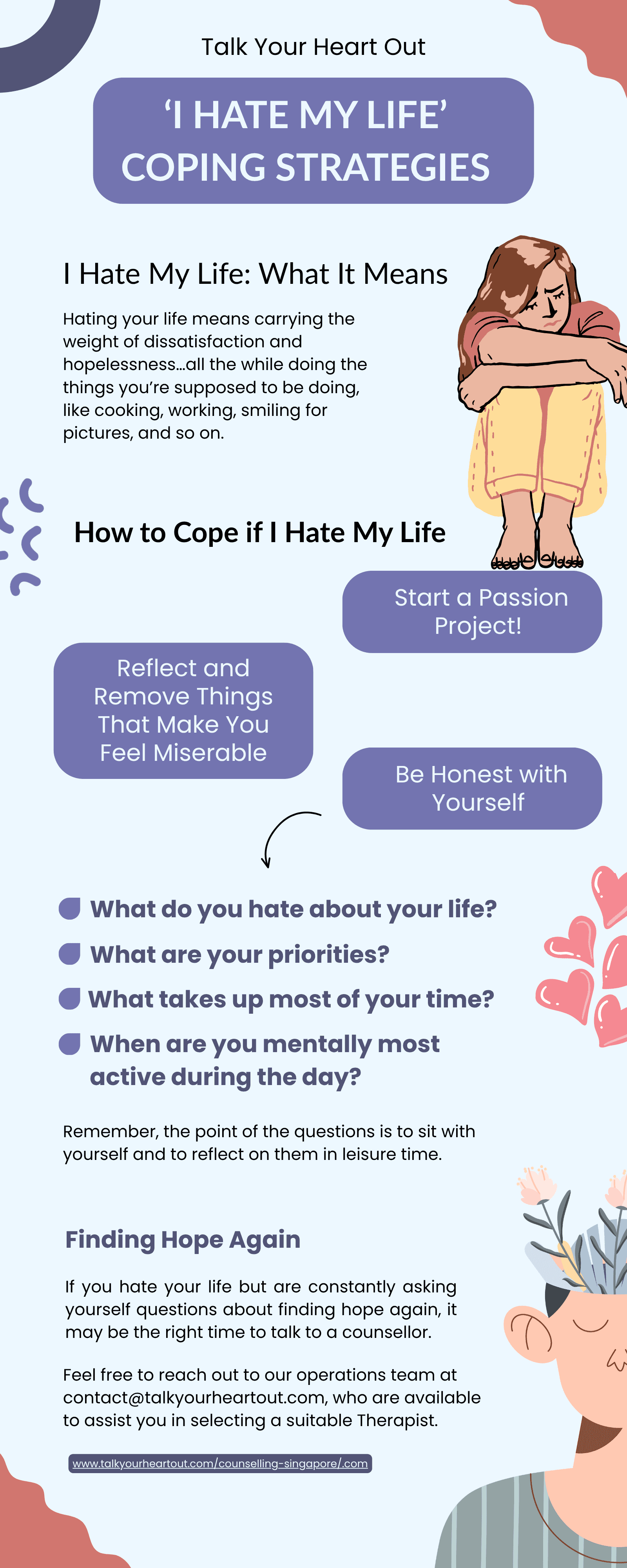
1) Reflect and Remove Things That Make You Feel Miserable
When you feel like you hate your life, you may think that you have no control. However, that’s far from the truth!
While you’re not in control of what actually happens in your life, you can control how you react or respond to situations.
For example, if you’re worried about a stressful work week, you can create an emotional safety system by booking a therapy session midweek with a professional to process your feelings.
If you think you might grow distant from your partner, try planning date nights or asking deep questions to build a healthy relationship.
Identifying your negative feelings and taking proactive action to manage them can be very empowering.
2) Start a Passion Project!
In our fast-paced world that rewards hustling, most of us have become a jack of all trades. It often means that we’re constantly preoccupied with a task, a hobby, a conversation, or a thought.
But…here’s how to flip the switch and make this work for you instead of tiring out your brain. Pick an activity you love and make it your passion project!
Stimulate your brain in as many ways as possible. Love writing? Start journaling and eventually post your essays or commentaries on a public platform. In fact, sharing your work with your friends can also keep you going. Enjoy cooking? Bake something fun and host an evening tea.
Making time for things you love will slowly and steadily remove the hate you feel in your life.
3) Be Honest with Yourself
Try to be honest with yourself about your life. Right now, are you thinking, ‘I hate my life’?
That’s okay. That’s your starting point. Ask yourself the following questions:
- What do you hate about your life?
- What are your priorities?
- What part of the day do you dread the most?
- What part of the day do you look forward to the most?
- Do you enjoy spending time with someone in your day?
- What takes up most of your time?
- What activities do you actually remember the most from your day?
- When are you mentally most active during the day?
- How much time do you spend on your screen?
Remember, the point of the questions is to sit with yourself and to reflect on them in leisure time; and there’s a reason for slowing down and giving yourself that space.
Research shows that holding space for yourself, reflecting, and feeling your feelings are profoundly connected to facilitating the journey towards healing.
When I was practising this activity, one thing that helped me most was focusing on one question at a time. I picked one, journaled for as long as my mind demanded, and sat with my reflections for a few minutes. I saved the rest of the questions for later days.
To give you an example, if it’s a rainy day, I sing my little heart out while I work on my creative tasks. On sunny days, I prefer to focus on practical to-do lists.

Almost 75% of people in talk therapy see positive outcomes within a few months.
Book a session todayWhen to Talk to a Counsellor: Finding Hope Again
If you hate your life but are constantly asking yourself questions about finding hope again, it may be the right time to talk to a counsellor.
A counsellor can help you:
- Explore the underlying source of your thoughts and feelings
- Put things into perspective
- Develop practical skills and self-care tools
- Lead a healthier, happier and more fulfilling life
It is particularly beneficial to talk to someone if you’re experiencing other symptoms such as:
- Loss of appetite
- Mood swings
- Apathy
- Loneliness
- Fear or a sense of dread
Often, the above symptoms could indicate issues such as social anxiety or depression. However, only an expert counsellor can determine the source by having a longer conversation and exploring your feelings in more detail and context.
At Talk Your Heart Out, your Therapist will guide you towards your journey of healing through:
- A personalised therapeutic plan (ie includes your therapy roadmap)
- An appropriate therapeutic approach
- Constant feedback and open communication
- Flexible adaptation to your needs and preferences
If you’re yet to book a session with us, do so on our app. You can use filters such as gender, issues, and languages to shortlist Therapists.
Read the professional's background, experience, and see what our clients have to say about them. Before deciding, you can also watch the Therapist’s introductory videos; these might give you a good idea of whether you'll get along.
Feel free to also reach out to our operations team at [email protected], who are available to assist you in selecting a suitable Therapist.

Frequently Asked Questions
1) How do I start feeling better?
To start feeling better, try to:
- Reflect on your feelings and journal your thoughts
- Identify what’s causing you dissatisfaction and remove these elements from your life if possible
- Reach out to your friends and community to stay in touch with your loved ones
- Sprinkle dusts of joy in your life by engaging in hobbies
If you’re still struggling, talking to a Therapist might be helpful!
2) 'I hate my life’ meaning?
‘I hate my life’ means that you are not happy with the way you’re living and the way your life currently looks. This could include your:
- Job
- Interpersonal relationships
- Habits and lifestyle
- Dietary choices or appearance
Identifying what the thought ‘I hate my life’ means to you is important, as it’s usually the first step in finding a solution to feel better again!
3) How to cope with hopelessness?
Try to start by focusing on what you can control today rather than trying to solve your entire life at once. Break overwhelming problems into smaller, manageable steps, stay connected to people you trust, and give yourself permission to rest. You are only human.
Dealing with hopelessness all along can be very difficult. Therapists at TYHO are safe, non-judgmental, and open-minded. If you feel hopeless, try talking to a Therapist today.
One Last Thing
Have you heard of the red car theory? If you look for a red car once, you’ll start to notice them everywhere.
So, here’s what we’re all going to do next. Every day, we’ll start to find little moments of joy hidden in corners of our lives we may not have thought to look for, and eventually, we’ll start to see that they’re all around.
We are joy finders, because we deserve a life we’re happy to live.
And remember, when you’re out there looking for a little joy, you’re never alone in doing it. Somewhere on the other side of the world, here I am, doing the same thing.