
You’ve probably heard married couples complaining about trust, communication, and intimacy. Maybe you’re in a marriage yourself.
After living with another individual for so long, you may start to experience some conflicts. Perhaps you’ve been arguing more than normal or notice an uncomfortable silence around each other.
You’re not alone. In Australia, more than 71% faced stress in their romantic relationships.
Marriage is a wonderful chapter of life; however, it’s normal to find it a bit rocky at times. If this sounds familiar to you, marriage counselling can help.
Counselling provides a confidential space to explore issues in your marriage. This article walks you through the process of marriage counselling and explores some effective therapeutic techniques.
Marriage counselling is a type of support where a therapist engages in a structured dialogue-exchange with the couple.
The sessions may result in improved communication, intimacy, and reduced conflicts. Every session is collaborative in nature. For example, the therapist does not side with a particular individual, and instead helps both partners face their feelings and thoughts in a non-judgmental manner.
At Talk Your Heart Out (TYHO), relationship counselling in Australia is available online through audio and video calls. Depending on your preferences, you may either wish to buy sessions individually or as a package.
TYHO Therapists typically use approaches such as emotionally focused therapy, the Gottman Method, and cognitive behavioural therapy. Sometimes, the professional may also use a combination of several methods to provide holistic support, known as an eclectic approach.
More importantly, marriage counselling is not just for those in crisis. Married couples at any stage of their relationship are encouraged to seek support to enrich their relationship and prevent any future conflicts.
Every marriage is unique, but some common problems may come up more often than others. For example, arguments, miscommunication, and a lack of intimacy are some of the most common issues that many couples may encounter.
Below are some issues that marriage counselling in Australia can help with:
There are no right or wrong reasons to seek support. If you’re struggling with an issue that’s affecting your interaction and bond with your partner, you may benefit from talking to a counsellor.

If you’re particularly seeking support to rebuild trust in your relationship, marriage counselling can help with that.
Sometimes, couples may lose trust due to reasons like infidelity, lack of communication, or frequent conflicts.
Marriage counsellors use evidence-based techniques to help you work through traumas, disappointments, unrealistic expectations, and feelings of emotional distance.
Let’s look into the three widely used marriage counselling techniques.
John and Julie Gottman developed Gottman's Method, and the tools are rooted in over 40 years of research and personal experience of their counselling approaches.
Gottman’s Method provides practical tools to build trust, deepen connection, and manage conflicts in marriage.
The method is particularly effective for couples struggling with:
For example, imagine a couple, Max and Lily, who always argue about how much time and energy Lily invests in her work. Max feels unloved and uncared for. Lily, however, likes working and doesn’t see a problem with it.
In marriage counselling, the therapist may use the ‘Aftermath of a Fight’ exercise to explore the argument. Instead of shifting blame, the couple may learn how to reflect on their underlying feelings during the argument. In this case, Lily may feel the indirect pressure to prove herself at work, while Max may be struggling with low self-esteem.
After an argument, find 20 minutes to work on this exercise:
If you’re not sure how to start this conversation during therapy, try saying this:
‘We fought this morning and I’m feeling upset about it. I’m sure we can work through this together. Could you help us explore what went wrong during the conflict and how we could’ve handled it better?’

Circular questions are a technique from systemic therapy. Australian counsellors may use this to move the conversation away from blame-shifting and towards a deeper understanding of each other.
Rather than asking, ‘Why did you do that?’, the therapist may encourage you and your partner to reflect on yourselves individually.
Circular questions are helpful for couples who:
For example, imagine a couple, Anne and Blue. Anne becomes anxious when Blue spends time with her friends without letting her know. Blue feels controlled and uncomfortable if she has to explain all her hangouts to her partner.
During marriage counselling, the therapist may ask circular questions such as:
‘Blue, what do you think goes on in Anne’s mind when she doesn’t hear from you?’
‘Anne, how do you think Blue feels when you ask for constant updates?’
These circular questions may help Anne realise that her anxiety could surface due to past negative relationship experiences or burnout. Blue may realise that her silence and lack of communication could lead to misunderstandings.
Choose a situation or argument that spiralled into a conflict. Take turns answering the following questions:
Engage in an open conversation about the questions and discuss your feelings with your partner.
If you’re unsure how to bring this up in a session, you could say:
‘We keep misunderstanding each other and getting defensive. Could we try some questions that help us see things from each other’s side?’
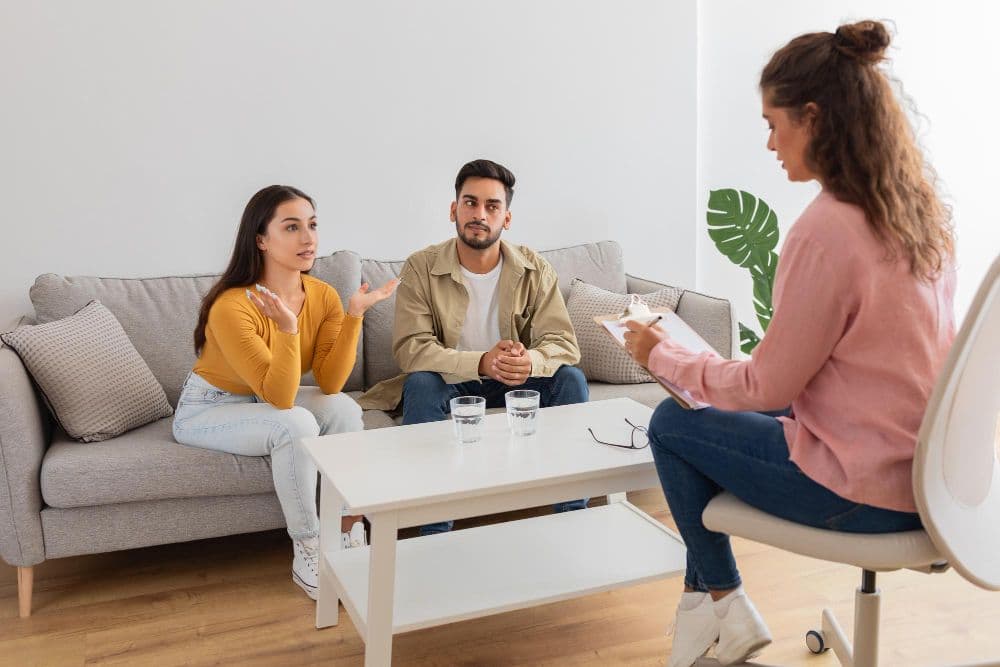
Tracking patterns is a technique that helps couples notice the negative interaction patterns they get stuck in. These patterns often surface during arguments, and most couples may not realise that they’re repeating the same cycle.
It is especially helpful for couples who:
Let’s look at Lee and Daniel. Lee tends to bring up issues directly and becomes emotional during the discussions. Daniel withdraws when things get heated or when they are expected to articulate their feelings. Over time, this cycle makes both partners feel hurt and misunderstood.
In therapy, the counsellor maps this out visually:
Understanding the cycle allows them to step out of it. They begin to see the pattern as the problem, not each other.
To bring this up during marriage counselling, try saying:
‘We feel like we keep repeating the same fight. Could you help us understand what’s going on and how we can interrupt that pattern?’
You don’t need to wait for major conflicts before trying some practical tools in your marriage. Conflicts are normal and may occur frequently. Hence, this section explores some tips you can try to deescalate issues and work on strengthening your bond.
Here are some tips to reconnect in a relationship:
It’s easy to fall into the usual conversations around chores and work. To avoid this, try taking out 15 minutes of your time daily to talk about one thing that you haven't previously mentioned.
Below are some conversation prompts and questions to help you get started:
Couples may forget to put intentional effort into improving their intimacy and trust. To do this, schedule date nights every other week and explore a different activity together.
Something as simple as watching a movie together after dinner could build your bond.
Another important aspect of building trust and reconnection in a relationship is visiting memories that gave both of you joy.
For example, you could flip through a photobook together, watch old videos, or write letters to each other.
People in relationships often enjoy hearing validations and affirmations (Note: Affirmation is one of the love languages). This is especially helpful when you’ve had conflicts or struggle to verbally express your emotions.
For example, try noticing one thing your partner does to make you happy. You could say: ‘It means a lot when you help me finish the dishes. Thank you!’
As explored in the previous sections, you don’t need to wait for a crisis or signs to seek marriage counselling. If you’re newly married, booking a session and attending therapy can act as a preventive tool to strengthen your bond.
Marriage counselling provides a safe space for rebuilding trust, enhancing communication, and fostering intimacy.
Counselling is helpful for couples at any stage of their marriage.
Common issues addressed in marriage counselling include miscommunication, trust issues, conflicts, and navigating major life transitions.
Marriage therapists may use techniques like Gottman’s Method, circular questions, and tracking patterns.
It takes effort and guidance to build a marriage. If you’re looking to work on your relationship, book a session with one of the expert TYHO counsellors.
"Love is totally nonsensical. But we have to keep doing it, or else we're lost and love is dead, and humanity should just pack it in. Because love is the best thing we do." - How I Met Your Mother
If you are in crisis, or another person may be in danger, do not use this site. Please refer to these resources instead.


Mon - Fri (excluding public holidays)
9.30 AM - 6 PM (+08:00 GMT)

TYHO acknowledges the Traditional Owners of the lands on which we work and pays our respects to Elders past, present, and emerging.

TYHO is committed to creating an inclusive space and welcomes people of all backgrounds, genders, sexualities, abilities, and cultures.
© 2026 Talk Your Heart Out Pte Ltd
Need Help? Chat with us