

Diana - Professional Counsellor
Master of Counselling (Monash University, Singapore); Singapore Association for Counselling (SAC), Clinical Member & Registered Counsellor (RC)
A Diana has experience working with individuals from diverse backgrounds and a wide spectrum of ages, from teens and university students to young adults and adults.
She utilises tools and strategies from Internal Family Systems, Acceptance Commitment Therapy (ACT), Solution Focused Therapy (SFBT), Attachment-Based Therapy and Cognitive Behavioural Therapy (CBT). In addition, she is trained in Brainspotting and can provide brain-body-based tools to work on deeper issues.
With a background in teaching and education management, she is also a passionate trainer in the field of mental health, providing talks and workshops in school and corporate settings.
She currently works as a Therapist with Talk Your Heart Out (TYHO). Her complete profile can be found here.
For managers, HR professionals, and people leaders, supporting employees through difficult moments is an important part of creating a healthy workplace.
At times, when a colleague may be dealing with personal challenges, unexpected news or a stressful situation, you may be unsure of how best to respond. This is where Psychological First Aid (PFA) comes in.
Psychological First Aid (PFA) offers a simple, compassionate, yet structured approach to supporting someone who may be experiencing distress. It can help workplace leaders and colleagues respond more quickly and confidently, providing appropriate support in the moment and recognising when additional help may be necessary.
Introduction to TYHO
TYHO is counselling and therapy service, and MOM-listed Employee Assistance Programme (EAP) provider, offering in-person and online therapy in Singapore. Our team consists of experienced Psychotherapists, Psychologists, and Counsellors in Singapore. We refer to all our mental health professionals collectively as "Therapists", given the overlap in their scopes of practice. A majority of our Therapists are members of recognised bodies such as the Singapore Association for Counselling (SAC) and the Singapore Psychological Society (SPS). If you'd like to explore our EAP and corporate wellbeing services further, get more details here.

Why is Psychological First Aid (PFA) Important?
Our psychological wellbeing can affect how we function at work, including our attendance, performance and relationships with colleagues.
Managers and colleagues are often in a position to notice when someone seems different from usual. For instance, a person may seem overwhelmed with their usual tasks, unusually irritable, or even quieter.
However, in such situations, many people fear saying the wrong thing, so they say nothing.
PFA provides a simple approach for offering practical and immediate emotional support while also recognising when someone may benefit from additional help and connecting them with such resources.
Psychological First Aid Explained
Psychological First Aid is a humane and supportive way of responding to someone experiencing distress. It aims to:
- Reduce immediate emotional distress
- Help them regain a sense of stability
- Connect them with practical and social support
What PFA is not:
- Counselling or psychotherapy
- Professional assessment and diagnosis by a clinical psychologist
- Solving every problem
- Getting them to talk before they are ready
Instead, PFA focuses on offering appropriate support in the moment and helping someone connect with further support when needed.
When Might PFA Be Useful?
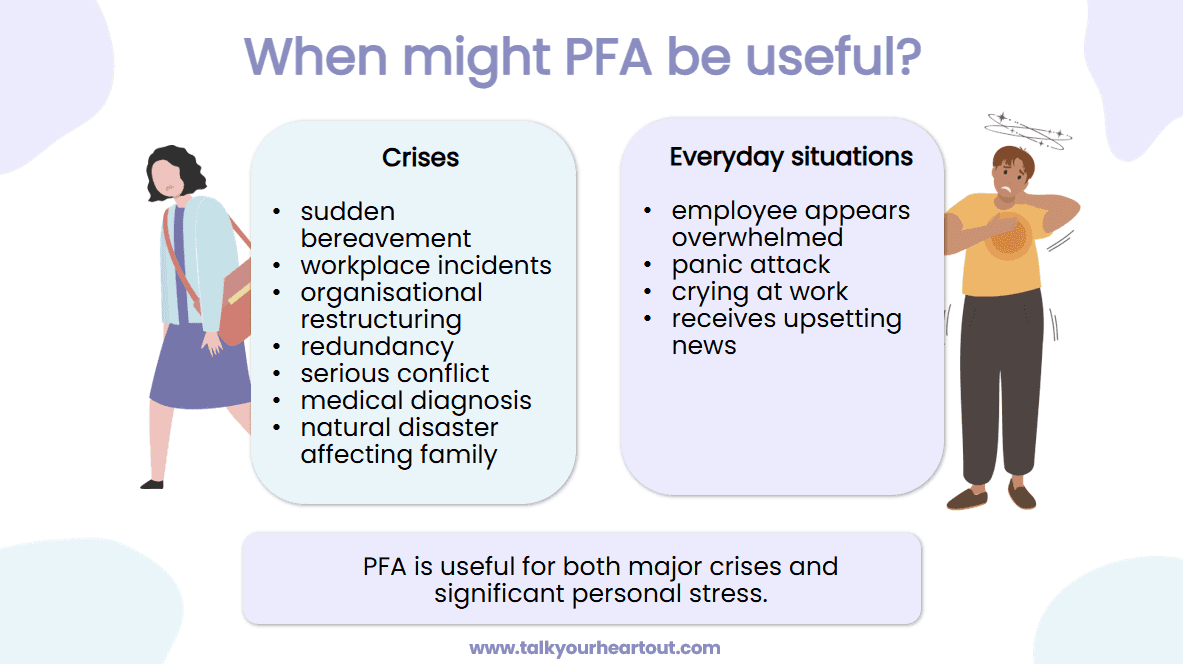
It’s crucial to remember that PFA is not limited to major crises. It can also be helpful when someone is experiencing significant personal stress or going through a particularly difficult moment at work.
Everyday situations may include:
- A colleague appearing overwhelmed
- Someone experiencing a panic attack
- A colleague crying at work
- Someone receiving upsetting news
More significant crisis situations may include:
- Sudden bereavement
- Workplace incidents
- Burnout
- Organisational restructuring or retrenchment
- Serious conflict
- A medical diagnosis
- A natural disaster affecting someone's family
A Simple Practical Framework
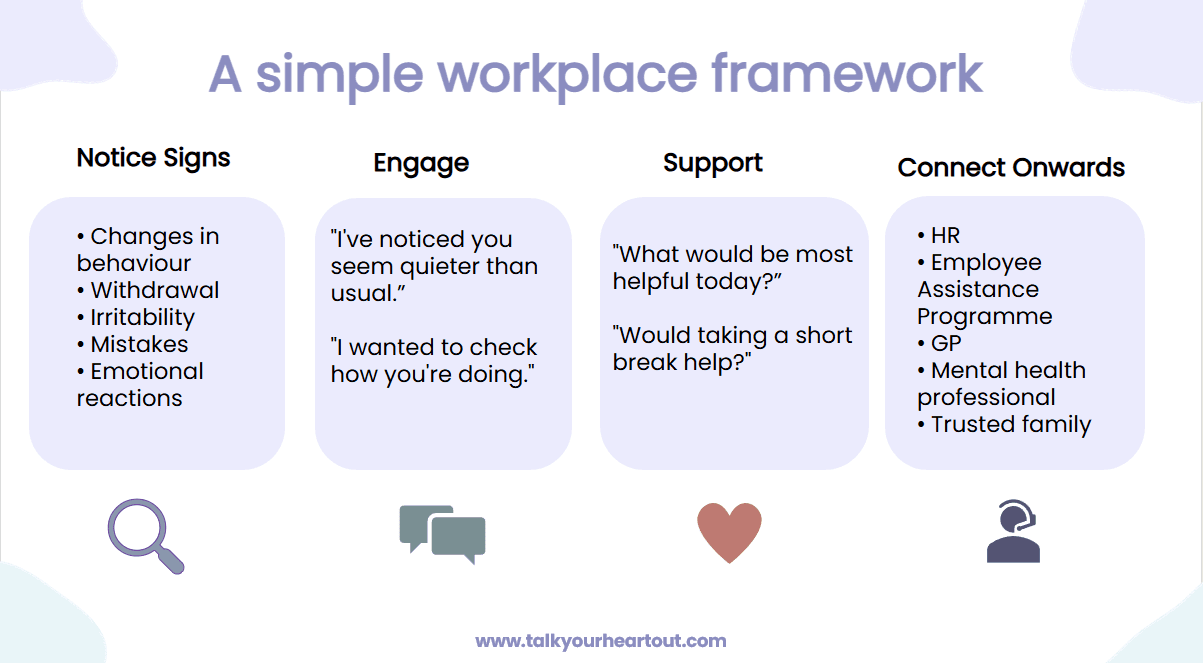
A simple framework to think about and apply PFA at work is: Notice, Engage, Support and Connect Onwards.
1) Notice
Pay attention to changes in someone's behaviour. You might notice that a colleague is:
- More withdrawn than usual
- Irritable
- Making more mistakes
- Showing strong emotional reactions
2) Engage
Start with a gentle check-in without making assumptions about what the person may be experiencing.
Here's something you could say to start the conversation: “I've noticed you seem quieter than usual. I wanted to check how you're doing.”
A simple, genuine acknowledgement and question can let someone know that they have been noticed and that support is available.
3) Support
Once you have checked in, give the person space to share what they are comfortable sharing.
Try to:
- Listen more than you talk
- Acknowledge what they are going through
- Give them time rather than rushing to offer advice
- Respect their choice about what they want to share
- Ask what might be helpful right now
For example:
- “I'm sorry you're going through this.”
- “What would be most helpful today?”
- “Would taking a short break help?”
Different people may need different kinds of support. Some may want to talk, while others may appreciate practical help. For some others, it may be helpful simply knowing that someone is there.
4) Connect Onwards
There can often be times when someone may benefit from additional support. Workplace leaders and colleagues can play an important part by helping someone identify and connect with the support that feels appropriate for them.
This could include:
- Workplace support: Practical support from a team lead or manager to manage workload, deadlines and projects based on the employee’s current emotional bandwidth.
- Employee Assistance Programmes (EAP): Workplace programmes that help employees access support for personal or work-related challenges, including stress and burnout.
- Mental health professionals: Mental health counsellors, psychologists and psychotherapists can provide a safe space to understand, process, and manage issues.
- General practitioners (GPs): A doctor can assess physical and mental health concerns, provide medical advice and recommend further care when needed.
- Family & community: Support from trusted family members or people in their community may also be helpful.
For organisations looking to improve workplace mental health support, an EAP can be a practical option. TYHO's Employee Assistance Programme (EAP) helps organisations support their employees' mental health through professional counselling and other tailored workplace wellbeing initiatives such as corporate wellness, grief support, retrenchment support, and on-site support.
By making support available proactively before challenges arise or become overwhelming, organisations can help improve employee mental wellbeing while building a more supportive workplace culture.

PFA Do’s & Don’ts
When someone at your workplace is going through a difficult time, here’s a simple Do's and Don'ts checklist that can help when offering support.
Do’s
- Listen more than you talk.
- Validate their experience. Let them know you recognise that they are going through something difficult.
- Respect their choices. Give them space to decide what they want to share or do next.
- Ask what they need. Their needs may not always be what you expect.
- Help them find further support when appropriate.
Don’ts
Even if well-intended, some phrases may not feel particularly helpful when someone is distressed, such as:
- “I think you should...”
- “Everything happens for a reason.”
- “Just stay positive.”
- “You'll be fine.”
Key Takeaway
Psychological First Aid is not about finding the perfect words or having a solution to someone's problems.
It is about noticing when someone may be struggling, checking in with empathy, listening without judgement and helping them find appropriate support when they need it.
Professional therapy , whether through Employee Assistance Programmes or otherwise, can be a great form of professional support when additional help is needed.
At the end of the day, a thoughtful conversation or simple gesture of support may not change the situation itself, but it can help someone feel less alone and remind them that help is always available.