


Master of Counselling (Advanced) (Swinburne University of Technology, Australia); Sexual Assault First Response Workshop (AWARE)
Avanti’s main goal as a therapist is to provide a safe space and a non-judgmental listening ear to all her clients.
She has experience in helping clients with anxiety, depression, grief, stress, infidelity, marital troubles, communication failures, stress and burnout, boundary setting in complex familial relationships, and demystifying relationships in their lives, both with themselves and with others.
Using Person-Centred Therapy (PCT) as a base, she develops therapeutic interventions tailored to her clients’ issues and desired outcomes, incorporating Cognitive Behavioural Therapy (CBT), Solution-Focused Therapy (SFT), Transactional Analysis (TA), and Family Therapy, among other approaches. She also finds mindfulness to be a wonderfully effective tool for many clients.
She currently works as a Therapist with Talk Your Heart Out (TYHO). Her complete profile can be found here.
Imagine this: It’s Friday evening, and you’ve just logged off after a long and tiring week at work. You’ve made plans to go out with friends. Just as you start to mentally check out and relax, the phone rings – it’s your mom.
You don’t really want to pick up the call, but you feel immensely guilty about not answering. You also know your mom might make a big deal out of it. You’re left feeling tired, conflicted, angry and guilty.
Does that sound relatable? If you answered yes, almost all young Asian adults are with you!
Many of us struggle with different types of boundary broaching by parents on a near-daily basis. These can include:
In this blog, TYHO Therapist Avanti answers questions from the audience on identifying and setting boundaries with your parents (especially in the Asian context). Following that, we also take you through a therapist-vetted step-by-step guide on how you can actually set and maintain those boundaries and how therapy in Singapore can help. Let’s get started!
Our platform connects clients to vetted and experienced Therapists in Singapore who are well qualified in providing couples counselling - both in-person as well as online therapy. A majority of our Therapists are members of recognised bodies such as the Singapore Association for Counselling (SAC) and the Singapore Psychological Society (SPS). If you'd like help with selecting someone suitable for relationship counselling or marriage counselling in Singapore, WhatsApp us at +65 9831 0005 or email us at [email protected].


Here’s what a conversation starter can look like in this situation:
‘Mom, I love how much you care about your grandson, and I’m always happy to hear your opinion, but please understand that I also have to consider my husband’s view on important things like education, even if he doesn’t share our thoughts every time.’
The guilt doesn’t always go away immediately, so it’s important to understand where the feeling comes from.
If you’re actively hurting someone or doing something you inherently believe is wrong, then the guilt is there to alert you to a problem.
If you’re setting a boundary that is designed to improve the relationship, know the guilt is probably misplaced, and will lessen over time when you see the boundary working.

Be gentle with yourself – sometimes you’re raised feeling unsafe to be honest. If you feel ready, you could slowly correct the story:
‘I want to be honest about something. While work was part of the reason I moved, the bigger reason was that I needed to explore who I am on my own terms. I was afraid to tell you that before, but I hope you can understand it’s not about distancing from you, it’s about exploring myself.’
Even if they don’t fully accept it, you’ve chosen authenticity, which is an important step.
Take a break, process, and then return.
You can say something like ‘I need a minute to gather my thoughts or go to the restroom,’ then, when you’re more emotionally regulated, come back in and express that your boundary was crossed, and what you would prefer to happen instead in the future.
Here’s something you can try:
‘Mom and Dad, I know you have so much more experience than I do with financial matters, but I worry that I’ll never learn if I keep looking to you for advice. Please know I’ll keep in mind everything you’ve already taught me, but I would love the opportunity to start being more responsible for myself.’
It can help to acknowledge their side of things while also letting them know that you’re open to having further conversations around it patiently. Here’s an example:
‘Boundaries are more topical now, and I know they’re a very new concept to you, as you didn’t have the same accessibility to create your own.
They are a way to keep us feeling connected, without any resentment or feeling of being drained on either side, and I’m happy to explain why I need certain things, and am always open to conversations around it.’

This is difficult because it involves not just emotions but also religion, which is a very sensitive point for many people.
I think boundary setting here could go like this:
‘I love both of you deeply, but I can’t force either of you to change your values. What I need is space to make decisions that honour both where I come from and where I’m going. I hope that over time, we can find common ground or at least mutual respect, even if we don’t agree.’
You don’t always have to come up with a solution immediately, and sometimes just communicating how a situation makes you feel is enough for the moment.
Boundary setting, especially in Asian families, can be an ordeal. Cultural norms and value systems fuel narratives such as:
Such narratives make it all the harder to establish healthy and lasting boundaries with parents. We may also:
We sat down with a professional therapist to bring you a step-by-step guide on how you can do that while being sensitive to their feelings and also protecting your own mental peace.
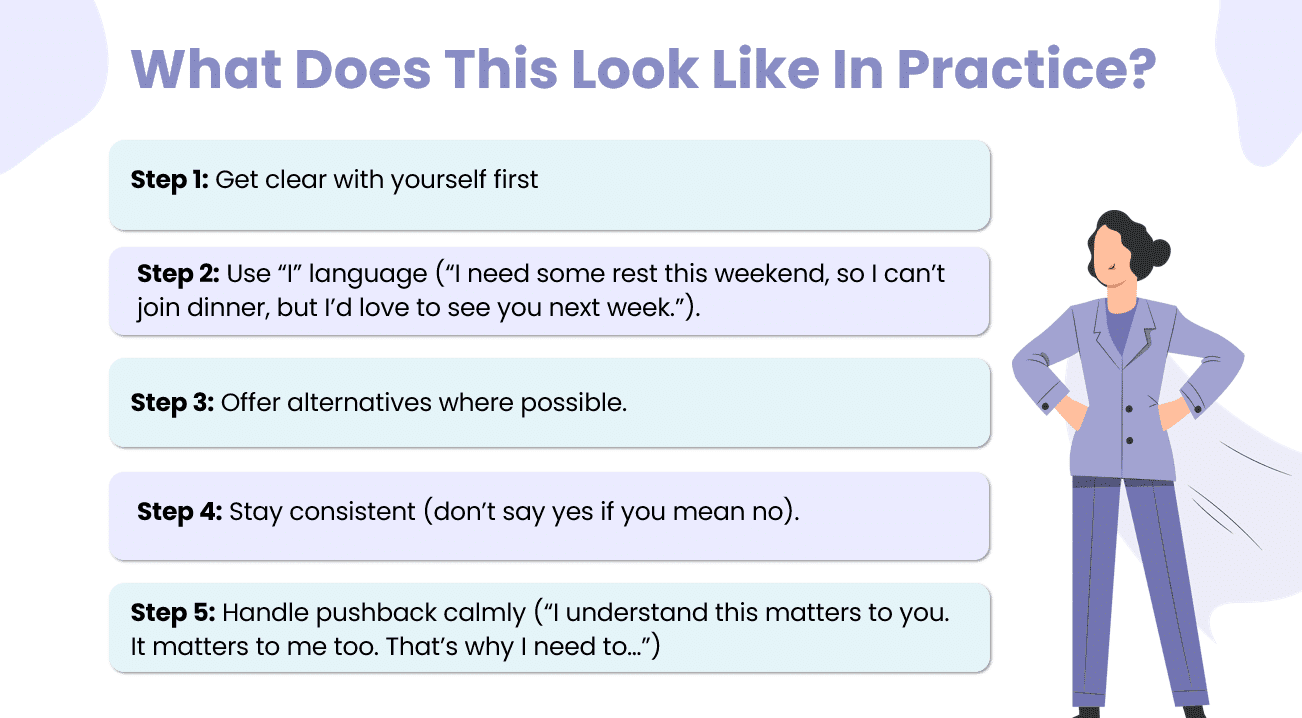
Clarity is always the first step. Take some time by yourself to understand the following:
Once you get clear about these crucial aspects, try to gauge how your parents might react. Think about possible retorts and replies, and practise how you want to react to that beforehand.
If you find it difficult to understand what boundaries to set and how to set them them, we encourage you to reach out to a therapist. Many of our Singaporean Therapists on TYHO are experienced in supporting clients with goals like boundary setting and parental relationships.
Now we come to actually communicating and setting the boundaries.
One of the most effective communication tools that’s often prescribed by therapists is learning to use ‘I’ statements.
I statements help you gently move from a blame-based approach to a grounded and objective approach. Focus on conveying what you’re feeling and how their actions are making you feel, rather than talking about them and their actions.
The shift is simple → ‘Why do you never understand I need my weekends?’ → ‘I need some rest this weekend as I had a busy week at work, so I can’t join dinner, but I’d love to see you next week.’
Here’s another communication tool that works wonderfully when setting boundaries.
Picture this: You’re at work and a colleague wants to schedule a meeting with you tomorrow. Your calendar is packed to the brim. What would you do?
Odds are you’d respectfully let them know that you don’t have an open slot that day AND provide an alternative slot after checking your schedule.
Offering alternatives tells the other person that they matter and that you’re willing to reach a middle ground.
For instance, if your father keeps making unsolicited comments about your career choice, here’s how you can offer an alternative:
‘I understand that you care about me and want to offer your advice on what you believe to be practical career choices. But I don’t share the same views, and this is what makes me happy. However, there are areas of my life that I’d like your help with, like investments. Do you think you can help me out with that instead?’
Consistency is, without a doubt, key to setting boundaries that last.
Saying something and then going back on it, or doing something that goes against it, is as good as, if not worse than, not setting the boundary in the first place.
Remember to be clear, respectful and consistent when you talk to your parents.
Tip: Spend quite some time on Step 1. It’s only when you’re clear with yourself that you can stay consistent with someone else!
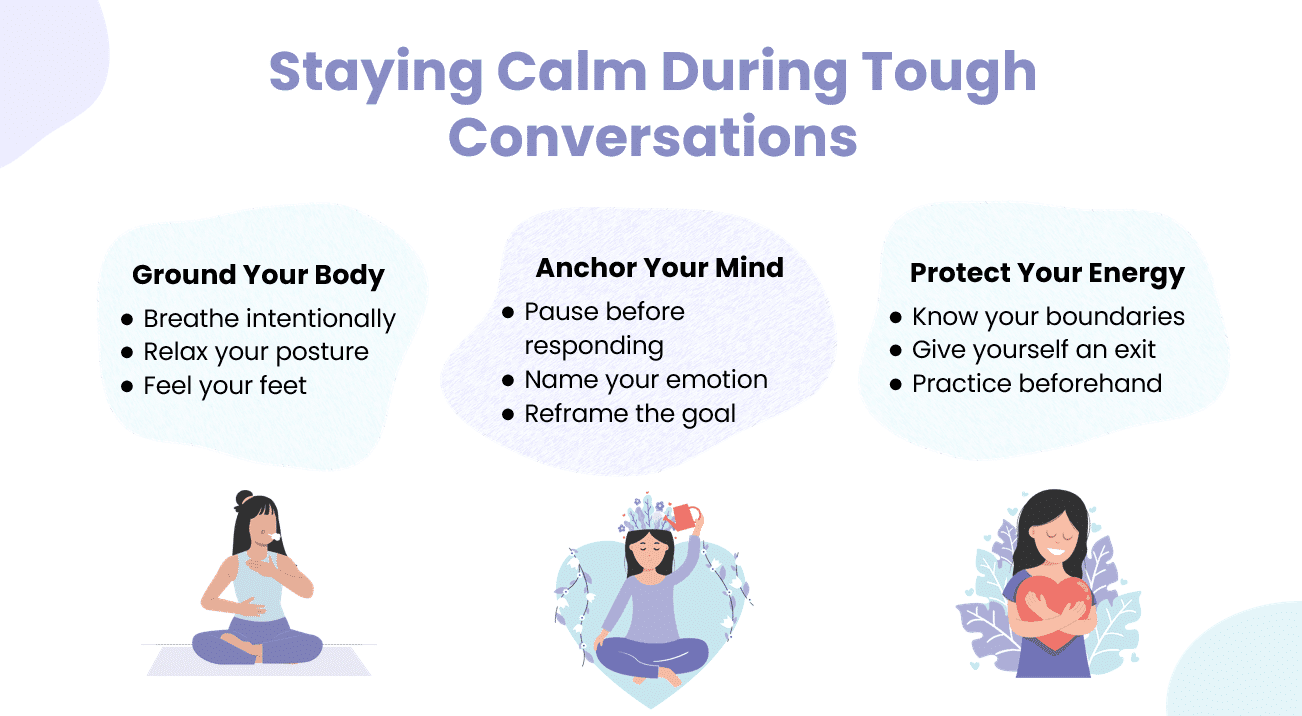
Pushback is often inevitable during difficult conversations. Some parents may also engage in guilt-tripping or gaslighting, even if subtly.
What matters is how you handle them. Below are some practical strategies to help you stay calm during such moments, without being carried away by strong emotions:
“Boundaries are the distance at which I can love you and me at the same time.”
This beautiful quote summarises what boundaries really are. They’re often misunderstood as putting up walls around yourself, but in reality, they’re more like fences with gates.
Boundaries give us greater control when we clarify and are intentional with what we can and cannot handle. They ensure you’re able to love others and yourself without resentment building up over time.
If you’ve been struggling with setting boundaries with your parents, here are some quick reframes to help you along:
Discomfort = growth
Honesty builds trust
Self-respect ≠ selfishness
Healthy love allows space
Everyone deserves respect
Once again, we’d like to acknowledge that boundary setting is especially difficult when it’s within the family and even more so in Asian families. Many Asians seek therapy to better navigate family relationships, communication problems, people-pleasing, guilt and shame.
Avanti is a professional counsellor at TYHO. She is experienced in guiding clients with boundary setting in complex familial relationships. Explore Avanti's profile and book a session to start your own journey. 💜

If you are in crisis, or another person may be in danger, do not use this site. Please refer to these resources instead.





Mon - Fri (excluding public holidays)
9.30 AM - 6 PM (+08:00 GMT)
OUE Downtown 2, 6 Shenton Way, #12-11B, Singapore 068809
© 2026 Talk Your Heart Out Pte Ltd
Need Help? Chat with us