


Master of Counselling (Monash University, Singapore); Gottman Method Couples Therapy (Level 1); Singapore Association for Counselling (SAC), Provisional Clinical Member
Glenn believes that every person deserves the following things: the freedom to express, the space to be heard, the time to heal, the ability just to be, and the belief that one can grow.
She works with older adolescents, individual adults and couples from diverse backgrounds over a wide range of issues, including relationship problems, depression, anxiety and grief.
Glenn adopts a collaborative and multimodal approach as she believes there is no one-size-fits-all in therapy. She is trained in Gottman Method Couples Therapy and Dialectical Behavioural Therapy (DBT), and incorporates elements of Schema Therapy and Mindfulness practices into her sessions.
She currently works as a Therapist with Talk Your Heart Out (TYHO). Her full profile can be found here.
Did you know that couples who never argue report 35% lower relationship satisfaction levels than those who do?
Statistics like these reveal the truth: conflicts, arguments, and fights are a normal part of healthy relationships.
It’s not about never fighting – it’s about how we do it.
Read on to explore a written interview with one of our experts who provide individual and couples therapy, managing conflict in romantic relationships.
Our platform connects clients to vetted and experienced Therapists in Singapore who are well qualified in providing couples counselling - both in-person as well as online therapy. A majority of our Therapists are members of recognised bodies such as the Singapore Association for Counselling (SAC) and the Singapore Psychological Society (SPS). If you'd like help with selecting someone suitable for relationship counselling or marriage counselling in Singapore, WhatsApp us at +65 9831 0005 or email us at [email protected].

Healthy conflict involves disagreement, but there is also respect, repair, and a sense of safety present.
Toxic conflict often includes contempt, blame, stonewalling, or feeling afraid of your partner’s reactions.
A key sign of a healthy relationship is not the absence of conflict, but the presence of respect, accountability and repair. If you’re consistently left feeling unheard, fearful, or disrespected, it may be time to reassess the dynamic.
Yes, preparation can help prevent fights from escalating out of control. Here are some ways you can do that:
TYHO couples counsellor, Glenn, says that when we argue, stress responses are bound to show up. When you shut down or cry, your body is trying to protect you.
Before conversations, practice grounding techniques such as:
During the argument, if you feel overwhelmed, it’s okay to say, ‘I need a few minutes to calm down so I can meaningfully engage.’
Then return when you’re ready. Over time, you’ll build tolerance for staying with tough emotions.
Recognising this dynamic is very important. Let’s call it the pursuer-distancer dynamic:
The pursuer needs connection to feel safe; the distancer needs space to regulate their emotions. Neither is wrong.
The key is timing and reassurance. The person who needs space should commit to returning to the conversation within a set time (eg ‘Let’s talk in an hour’), and the pursuer needs to respect that boundary.
The one needing connection can focus on self-soothing while waiting, knowing they’re not being abandoned.
Post-conflict repair is essential. After a fight, try a reconnection ritual – a small gesture that signals you’re still a team, such as:
Give each other space to process, but always commit to coming together to reflect on what happened and what each person needed. This bridges the gap between different emotional recovery speeds and prevents resentment from building up.
Recognise that both emotional expression and problem-solving are valid needs.
Validate each other’s approach through verbal assurances like: ‘I know you need to express your feelings’, or ‘I know you want to find a solution.’
Then take turns. Begin with emotional sharing, using ‘I feel’ statements, and ask the practical partner to simply listen.
Then switch gears to brainstorming solutions together. Respecting both styles builds empathy and balance.

Never underestimate the power of asking your partner about how they are or how their day has been.
Even a small thank you when it comes to something like doing the dishes or grabbing you a glass of water goes a long way.
Set aside time to talk meaningfully about how the relationship is going.
Before reacting, ask yourself, ‘What’s really bothering me?’
These small habits can build emotional safety and reduce conflict over time.
It’s always helpful to consider timing and setting when choosing to initiate conversations. No one likes to be caught off guard.
Approach the conversation with curiosity about your partner’s perspectives, instead of approaching with blame.
Invite your partner to share their perspective, and mutually reflect, while also acknowledging your part in the situation.
If you find yourself feeling defensive, be curious about that. ‘Why is this hard for me?’ This can open up both your perspectives and promote deeper honesty and less reactivity.
According to Dr. John Gottman, happy and fulfilled couples report engaging in an average of one to two conflicts per month.
The reasons for relationship conflicts can arise from a range of factors, such as misalignments in:
Misunderstandings and conflicts may also stem from common relationship pitfalls like:
Below are four couples therapist-vetted practical strategies to go from ‘I don’t know how to resolve this!’ to ‘We can get through this as a team’:
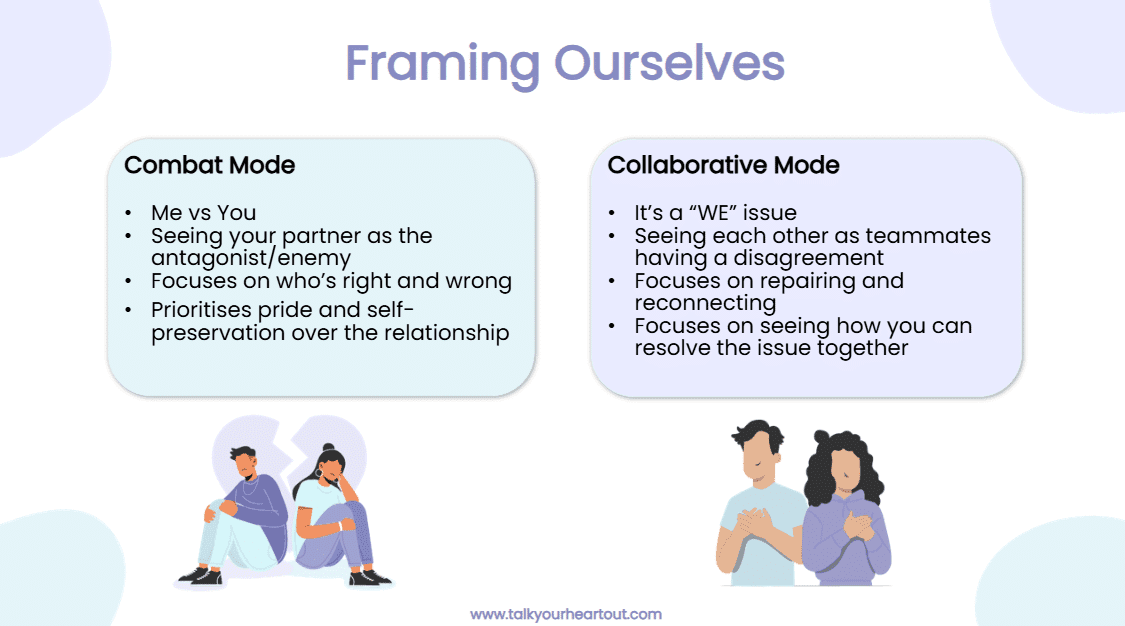
When dealing with a conflict, it’s important to frame ourselves the right way, the healthy way.
In the heat of the moment, when emotions take control, it can be easy to go into combat mode – viewing the conflict as you versus your partner.
However, in order to de-escalate and engage in healthy conflict resolution, it’s essential to shift from combat to collaborative mode.
The illustration below shows a quick differentiation between combat and collaborative modes:
There’s immense power in a pause. Research shows that even a five-second pause can help de-escalate an argument.
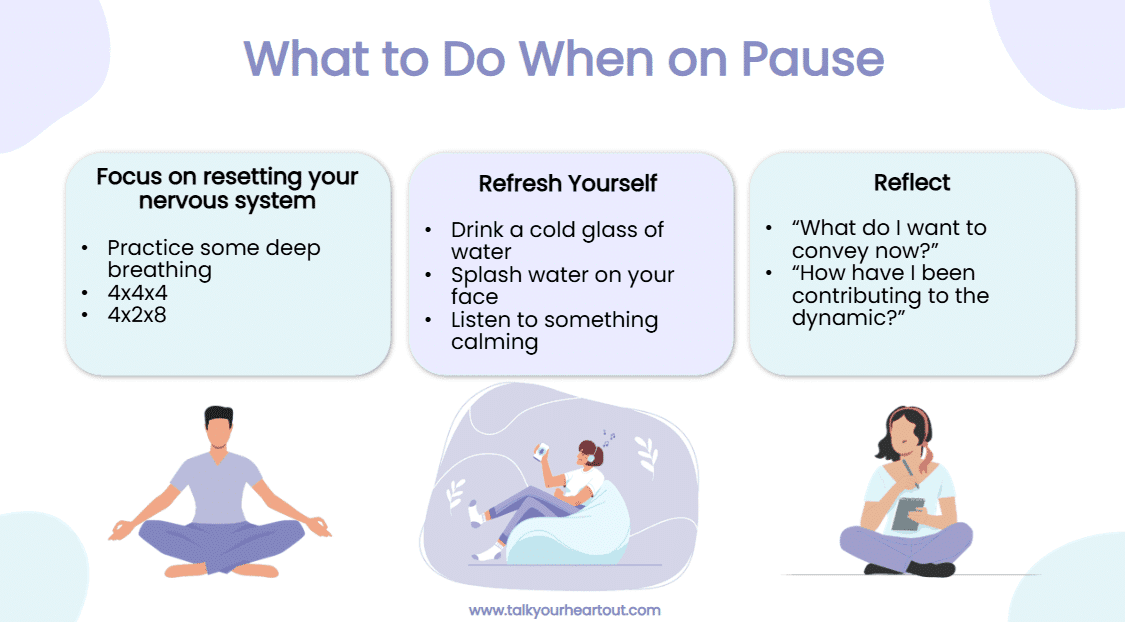
During a conflict, if you find your emotional overwhelm slipping out of control, take a short break. This can be as short as taking a deep breath or as long as a few hours.
Remember to voice your need for a time-out and commit to returning to the conversation at a set time.
Here are some things you can do during a time-out:
When a conflict does get out of hand, anger can build up, and you may say things you didn’t really mean or be harsh with your words. It’s important for both partners to make repairs once they realise this.
Words and actions are powerful tools for showing affection and reconnecting with your partner during or after an argument.
Remember that you’re negotiating with someone you love and care about, not fighting against an opponent.
Below are some practical examples of verbal repairs:

In addition to using verbal repairs, you can also show your affection through actions like:
However, be mindful of their boundaries and always check whether they’re comfortable with such acts of affection in the moment.
During arguments or heavy discussions, it’s crucial to both speak mindfully and listen actively and reflectively.
By mindful speaking, we mean:
Reflective listening is the act of ensuring your partner feels heard and understood, not merely listened to. When we engage in reflective listening, we become more empathetic, less defensive and open to connection and understanding.
Here’s what reflective listening can look like:

Once again, we’d like to reiterate that it’s not aboutfighting – it’s about how we fight.
Conflict can often be an opportunity to collaborate and connect more deeply as partners. By learning to engage in conflicts in healthy ways, you can strengthen your bond and grow closer to your partner.
Couples counselling in Singapore can be a safe and guided avenue to navigate relationship conflicts. Here are some key ways a therapist can help you with this:
Identifying, analysing and understanding the root causes of conflict
Setting healthy boundaries and holding space for each other
Navigating differences or mismatches in values, beliefs, and expectations
Learning practical conflict de-escalation, resolution and reflection strategies, tools and techniques
Working together as a team and reconnecting emotionally
Book your couples counselling session.💜
If you are in crisis, or another person may be in danger, do not use this site. Please refer to these resources instead.


Mon - Fri (excluding public holidays)
9.30 AM - 6 PM (+08:00 GMT)
OUE Downtown 2, 6 Shenton Way, #12-11B, Singapore 068809
© 2026 Talk Your Heart Out Pte Ltd
Need Help? Chat with us