Starting a relationship can be exciting. It’s a new chapter of life!
But similar to all life stages, romantic relationships may also come with challenges that you may not know how to handle. And that’s okay.
If you feel like you and your partner may benefit from change and growth, couples counselling is just the intervention you may need.
Couples counselling in Singapore can help if you engage in frequent arguments, struggle to express your thoughts effectively, or clash due to external stressors like job anxiety.
If you’ve already decided to seek help for one or more of the above, but are unsure of what type of therapy may help, this article is for you.
In this piece, we’ll cover the differences between couples counselling and marriage therapy, and address some commonly asked questions about the therapy process.
Our platform connects clients to vetted and experienced Therapists in Singapore who are well qualified in providing couples counselling - both in-person as well as online therapy. A majority of our Therapists are members of recognised bodies such as the Singapore Association for Counselling (SAC) and the Singapore Psychological Society (SPS). If you'd like help with selecting someone suitable for relationship counselling or marriage counselling in Singapore, WhatsApp us at +65 9831 0005 or email us at [email protected].

At Talk Your Heart Out (TYHO), we provide couples counselling in Singapore in several locations. Additionally, you may opt to book either in-person or online sessions. The best part is that you have no pressure to stick to one modality.
For example, you can schedule online sessions when you are busy travelling and then transition to in-person sessions with the same Therapist when your calendar is free.
Below is a brief overview of the counselling process:
If you’re considering couples counselling and haven’t spoken to your partner yet, here’s an activity that can help break the ice:
Step 1: Write
Both of you can spend 5-10 minutes writing down answers to the following questions:
Step 2: Share
Choose a time when neither of you is distracted, perhaps after work or early in the morning. Take turns and share your answers. Remember not to interrupt each other during this step.
Step 3: Listen
As your partner shares, repeat back what you heard in your own words (eg ‘So you feel overwhelmed when we argue about money, and you’d like us to find a calmer way to talk about it?).
Step 4: Introduce the idea of counselling
After both of you have shared, try asking: ‘Would you be open to getting some guidancetogether, like couples counselling, so we can figure this out in a better way?’
Often, people use the terms' couples counselling' and 'marriage therapy' interchangeably. However, there are some subtle differences.
Couples counselling is usually short-term and focuses on the present issues. Sessions are person-centred and solution-oriented.
Below are some of the areas that couples counselling can help with:
For example, let’s consider a couple, Raj and Alia. They often fight about money every week. However, during couples counselling, the Therapist may introduce tools such as ‘I Statements’ (eg ‘I feel anxious when we spend a lot…’) to help resolve conflicts healthily and effectively.
Tip: If your main struggles are daily arguments or emotional distance, couples counselling is often the right first step.
Marriage therapy is sometimes referred to as marriage counselling. Sessions delve into deep-rooted issues and focus on long-term treatment plans.
Marriage counselling can help with:
Tip: If your marriage feels weak due to betrayal, resentment, or long-standing conflict, marriage therapy can be the right option for you.
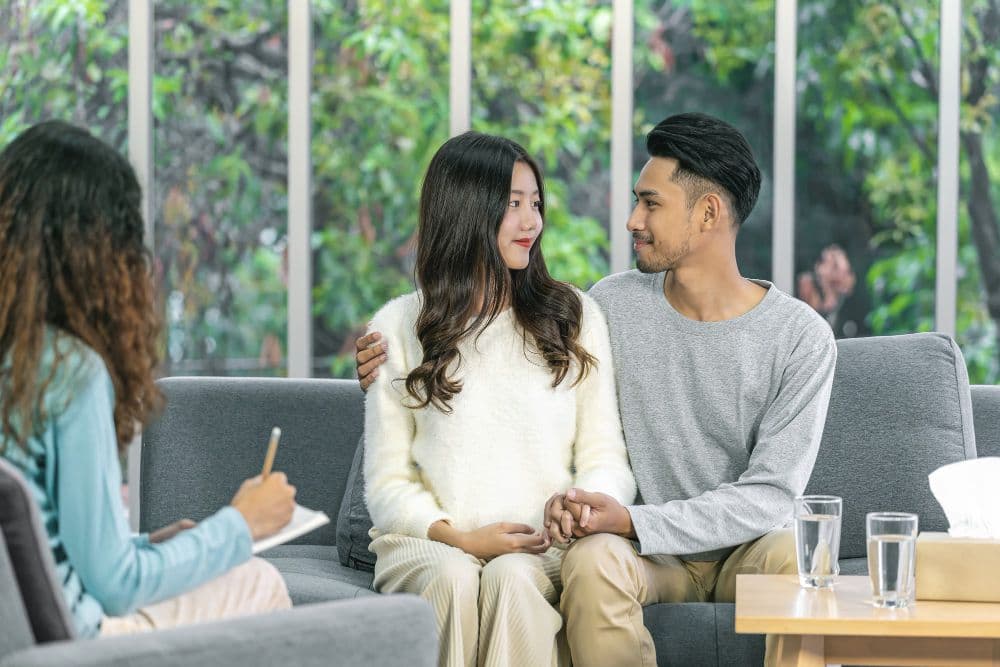
Another important difference lies in the way these two approaches are conducted.
Couples counselling is usually structured, practical, and focuses specifically on the issues that a couple wants to address. The counsellor may introduce exercises, worksheets, or role-plays to help partners practise healthier communication. The aim is to build skills that can be applied directly in everyday life. Couples typically attend around 8 to 12 sessions over the course of a few months to enhance their bond and improve their interaction.
Marriage therapy tends to be more intensive and exploratory. The therapist guides couples to look beyond the immediate conflict and examine the deeper causes — such as expectations, emotional triggers, or unresolved trauma. The process is open-ended, and while both partners are usually present, therapists may occasionally recommend individual sessions to gain a deeper understanding of each person’s perspective. The pace can feel slower, but it allows couples to understand the root causes of their presenting problems before moving on to the solution.
Couples counselling in Singapore may be the right option if you’re struggling with present issues like communication problems or recurring arguments.
Marriage counselling may be the right option if you want to explore deep-rooted issues in your marriage and navigate marital dynamics.
Individual counselling alongside couples therapy may work the best if you struggle with personal mental health challenges (like trauma or anxiety).
If you’re ready to get started, book a couples counselling session at TYHO. You are not alone.
Yes, couples counselling is different from that of marriage therapy.
On the one hand, couples counselling is the right option for you if you are:
On the other hand, marriage counselling is the right option for you if you are:
The 555 rule is a simple exercise to improve the quality of your romantic relationship.
This is the idea: spend 5 minutes daily, 5 hours weekly, and 5 days yearly to intentionally connect with your partner.
For example:
Many couples hesitate to book their first couples therapy sessions. The main concern is whether therapy will actually be effective.
The short answer is: Yes, couples counselling in Singapore is worth it, especially if you’re stuck wondering what went wrong with your relationship and how to fix it.
Couples counselling provides a neutral space where both partners can speak openly and honestly. A professional will guide and maintain the pace of the conversation, allowing partners to avoid blaming or guilt-tripping each other.
In Singapore, many couples also face external stressors, such as balancing demanding careers, managing expectations from extended family, or coping with the high cost of living. These stressors can aggravate small disagreements.
In such cases, couples counselling can effectively improve your:
The answer to whether you need couples or individual counselling depends on the type of your presenting problem.
If your issue is between you and your partner, such as arguments, communication or intimacy issues, couples counselling is usually the right choice.
However, if your issues are related to your mental health or other external stressors like work anxiety, then individual counselling may be more beneficial.
For example, if you’re struggling with social anxiety, which is causing strains in your romantic relationship, a combination of individual and couples counselling may be the best approach for you.
If you’re confused, try talking to your partner. If your loved one feels like they may also benefit from therapy, you can try couples counselling. Have an open discussion with your therapist to explore which type of therapy is the right choice for you.
Ask yourself this question: Are we mainly struggling with ‘us,’ or am I personally struggling with something that spills into ‘us’?
If you are in crisis, or another person may be in danger, do not use this site. Please refer to these resources instead.


Mon - Fri (excluding public holidays)
9.30 AM - 6 PM (+08:00 GMT)
OUE Downtown 2, 6 Shenton Way, #12-11B, Singapore 068809
© 2026 Talk Your Heart Out Pte Ltd
Need Help? Chat with us